Next big thing - underworld time has come today
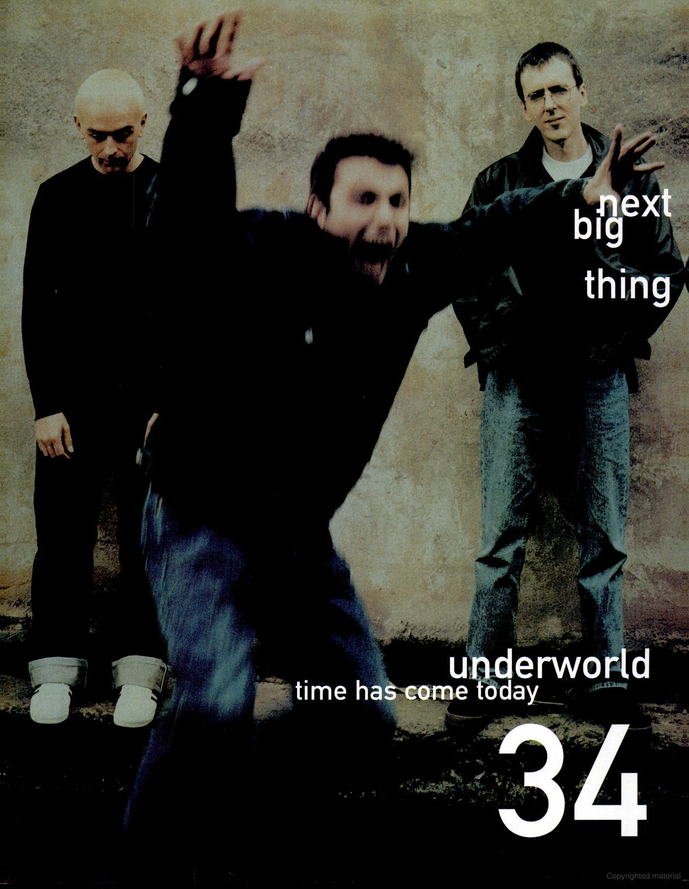
CMJ New Music Monthly | #65 | January 1999
STORY: MATT ASHARE PHOTO: HAMISH BROWN
a little research and development makes a group that was once just a footnote to the late '80s uk pop scene the groove band of these times.
Cut to the late '80s. The Reagan/Bush/Thatcher years. Madonna is cool and Michael Jackson still vaguely resembles a carbon-based life form. But lurking beneath a seemingly stable business-as-usual façade are certain telltale signs of an impending crash. A swift proliferation of hair-farming metal bands in America has created an acute but short-lived shortage of spandex in the Western world. British synth-pop saturation has intensified to nearly toxic levels. Duran Duran has just spawned a side-project called Power Station."Ah, the curse of the late "80s." reflects Underworld's Karl Hyde in mock horror from his home base in the late "90s, the London building that houses Underworld's recording studio and the offices of the Tomato graphic arts collective he helped found. He's thinking, of course, of the days when he, then a singer/guitarist, and keyboardist Rick Smith were desperately seeking stardom as Underworld, a synth-pop band in the style of. oh, say. Heaven 17 or maybe Talk Talk. Having started the decade in an artier post-punk band called Freur, which issued two LPs on CBS, Hyde and Smith released two albums with Underworld on Sire, toured the US once, and broke up. "We started off with great intentions," Hyde points out. "But it somehow got watered down by the idea that there were systems by which you could become famous and make lots of money. And that just didn't work, at least not for us."
Cut back to the late.'90s. The Clinton/Gingrich/Lewinksy years, as they'll likely be remembered for generations to come. Madonna's still cool and Michael Jackson, well, let's just leave that one alone. The grunge, punk, and indie-rock that made moshing this generation's Twist have sucked every last bit of meaning from the word "alternative" and lost their relevance. Kids are dancing across the great divide that once separated the guitars of "Highway To Hell" from the techno grooves of Kraftwerk's "Autobahn." R.E.M. is using a drum machine.
The time, as they like to say, is right for Underworld. But, though Hyde and Smith are still at the helm, this isn't your older brother's Underworld. In fact, the two albums Underworld released on Sire in the late '80s aren't even mentioned in the group's official bio. Yes, the as-yet-untitled but completely finished new album Underworld will release on V2 in early 1999 will be promoted as its third full-length. But that's because Underworld mach 2-a trio also featuring DJ Darren Emerson - has already put out two CDs, dubnobasswithmyheadman, released in the UK in'93 and the US in "94 (Wax Trax !- TVT) and 1996's Second Toughest in The Infants (Wax Trax !- TVT). Indeed, when the trio toured this country behind Second Toughest it was billed as the group's first-ever swing through the US, despite the fact that a band named Underworld and featuring Hyde and Smith had been Stateside back in 89.
"Yeah, well, it was really another band," Hyde explains. "We've brought some things along with us, but what we've become in the '90s is really a new thing. I mean, we had a couple of records on Sire as Underworld, and before that we had two records on CBS. But this was the one opportunity we had to do what we wanted to do. How many shots does someone normally get?" Underworld got its second lease on life by plugging into what would become the post-grunge zeitgeist of the '90s early on, namely the Dj club culture that spawned everything from big beat sensations like the Chemical Brothers and Fatboy Slim, to junglists like Goldie and Roni Size, to rock cum techno acts like the Prodigy. As Hyde tells it, "When we started off we had a very specific idea: Rick wanted to work with a DJ. It had become very clear to us that over the years we'd been denying the fact that we were heavily into groove. In the ‘80s we would never dirty our hands by making music people could dance to. But it really became clear at the end of the decade that that's really what we'd always wanted to do, right from the beginning of Freur even. So Rick decided to work with a DJ and make music for the dance floor. And from that we could do our own market research, by having Darren play tapes and acetates on the dance floor when he was out spinning as a DJ. Then, we could go back and remix tracks ourselves, because fortunately Sire had left us with a recording studio when they dropped us, which was very nice of them. So we were very self-sufficient in that sense. We just wanted to make dance records-in the early ‘90s that was our greatest ambition. And then we just sort of seemed to make a career out of it."
A big part of what made possible Underworld's dance-music explorations, which have included forays into everything from trance tracks to drum 'n' bass, is Tomato, the multi-media commercial arts collective Hyde and Smith created in the wake of the end of the first incarnation of Underworld.
Tomato, which has grown to include nine members, has credits that include Nike television advertisements, a Rolling Stones album cover, various videos, and an art book titled Mmm Skyscraper I Love You. "Tomato started off as a group of people who got together at the end of the '80s because we were either dropped from our labels or we had companies that were going bust or whatever," Hyde recalls. "It was based around a group of, for wont of a much better term, graphic-based artists who were doing things like record sleeves and paper-based adverts. Then we moved on to doing TV commercials. Rick and I got involved in making the sound for the commercials. It helped us enormously with not having to compromise what we wanted to do musically with Underworld. You know, we could pay the rent quite nicely, run a company, and make the music that we wanted to with Underworld without having to worry about how it went over.
"So Tomato was very, very important in the formative years of Underworld. It helped us to do the things we really wanted to do rather then the things that we felt we should or needed to do to become pop stars. It's funny. as soon as we gave up trying to do well, we did well. Or, at least, as soon as we gave up trying to become famous and got on with the business of enjoying what we were doing with Underworld, we made our first profit and started to do well. I suppose it had a lot to do with taking on the attitude that it didn't matter how well Underworld did because as far as we were concerned we had a career with Tomato that we could earn nice money with. And I think it's true for a lot of people that as soon as you let go, that's when it starts to flow."
Two elements Underworld didn't entirely let go of when it took its "90s DJ plunge into a realm where synthetic-textured instrumentals are often the rule were Hyde's vocals and his guitar. Both lent a distinctly familiar flavor to the trio's first two albums, which helped blaze the trail for the sort of rock-techno fusions that have made the Prodigy such a hot commodity. "I think a lot of people who came to our concerts early on were coming to what was essentially a dance event for the very first time," Hyde hypothesizes. "They heard the dubnobass album, and they heard sounds on there that they could recognize from more traditional guitar-based music. And I think that opened a lot of new people up to dance music, simply because there was something familiar in the music for them to associate with."
The guitars, which have a much lower profile on Underworld's forthcoming CD, were and remain part of an equation formulated and then tweaked to meet the needs of the dance floor. "The truth of the matter is that, well, initially, what was great about having a DJ in the band is that he was instantly a sensibility that we had access to that we didn't understand," Hyde admits. "We felt groove and rhythms but we didn't understand what was happening on the dance floor. And we really didn't have the time to learn how to cut records and stuff. So, by having a DJ, we had someone to tell us what was going to work and what wasn't going to work.
“Then, as the years went by, having a DJ helped give us the confidence to do things that Rick and I might have steered clear of with a vengeance-things that might remind us too much of our past because they were too rock or too full of guitars. Darren would step in and tell us that it was really cool because he wasn't used to that sound. He was coming from a completely different background. His background was very old school hip-hop. That was very refreshing. He was a young guy who was giving us the confidence to mix up sounds that we would have just dumped.
"What's great about having Darren around now," Hyde continues, "is that outside of being in Underworld he's still DJing all over the world. He has something of an A&R-type vibe in that he can tell us what does and doesn't work on the dance floor. So if Rick and I are working on something we can check with him. Or we'll just give him a dub plate and he'll go play it at a club. And he can come back and tell you to leave it as it is, or to beef the kick drum up, or whatever. Basically, we have our own market research. We don't have to rely on a committee telling us what the kids want."
Of course, these days the kids want a lot of different things from a band, and reaching out to them entails doing more than just 12" dance singles. So Underworld has adapted and diversified, first by making albums that stand up as more than just singles collections, and then by putting together a dynamic live show that includes a fair amount of the sort of "playing" normally associated with more organic rock outfits. "There are really three elements to Underworld," Hyde points out. "We're a group that makes records for the dance floor very specifically: we're a group that makes full-length albums; and we're a group that plays live. And the music has developed to the point where live concerts are a big part of what we do."
Though you might not guess it from the synth 'n' beat-sequenced sound of the new tunes, which bring to mind the sort of rhythmically intense pop New Order was delving into back when it released "Confusion," Underworld's live shows were a big influence on the forthcoming CD, both in terms of how the tracks were conceived and how they were constructed. "Everybody in the crew is a live jammer, whether they're doing sound, lights, or whatever," Hyde explains. "Everything we do on stage is improvised. And that had a big impact on how we recorded the new album because we started the album after we'd just played a string of European festival dates. We set up our live equipment in one end of the studio and whenever we got stuck on an idea we'd just turn it on and jam. It's a lot of technology-a 56-channel mixing desk, vocoders, triggers, drum machines, samplers, and sequences-but it's accessible in a very live way. That allowed us to jam directly to the hard disk instead of sitting there for weeks cutting and editing and pasting."
All of which has Hyde now looking forward to the chance to take the new material out on the road in front of the expanding audience for electronic music-an audience that's less and less concerned with labeling it as anything other than just music. "We've consciously tried to stay away from movements and whenever it was possible for people to label what we were doing we would move on. When it was trance music we moved on, and when it was drum 'n' bass we moved on. When we went to the US in 1996, the idea of coming to a place where there was this electronica' label horrified us. But I have to say that we were really encouraged by what we found. New York was suddenly becoming like Glasgow, which is one of the best places in the world to play, a place where people were really turned on by the music to the exclusion of having to follow any trends or being chic or standing at the back of a club waiting to be impressed. It was like going back a couple of years to the formative period of this music in England. It was very exciting for us, like a big birthday party."
END
